Emergency Water Extraction in Greeley, CO
Standing water keeps wicking into drywall and subfloor until it is pulled out. The extraction crew removes it with truck-mounted pumps and wands, then the drying team takes over.
(888) 532-8620Get Greeley emergency water extraction started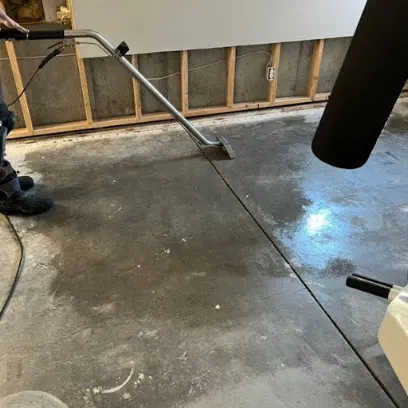
First steps for emergency water extraction in Greeley
- 1
Stop the source
Close the main shutoff or the fixture valve so no new water enters.
- 2
Stay clear of outlets
Keep out of standing water near cords, outlets and appliances.
- 3
Photograph it
Shoot the water line on walls and floors before anything moves.
- 4
Call for extraction
Every hour of standing water adds drying days and removal.
How emergency water extraction is handled in Greeley
Rapid local response
The response team rolls day or night across Greeley and Weld County, because a basement keeps soaking up water until extraction starts.
IICRC S500 drying standard
The drying team dries the structure, not just the surface, and pulls the equipment only when the readings say dry.
Claim-ready documentation
The tech who does the walkthrough maps the moisture, photographs the loss before demolition and logs daily readings for the adjuster.
Weld County water experts
Subzero cold snaps, hail season, window wells, swamp coolers and river flooding: local water damage experts know how water moves in a Greeley home.
What does emergency water extraction cost in Greeley, CO?
In Greeley, CO, emergency water extraction typically runs $800 to $4,500, depending on the water category, the square footage and how deep the water stands. Drying equipment is usually billed separately by the day.
| Scope of the loss | Typical range | What drives it |
|---|---|---|
| One room, clean water | $800 to $1,600 | Under 200 sq ft of carpet or hard floor, caught early |
| Basement or several rooms | $1,600 to $3,200 | Standing water, pad removal, portable plus truck-mounted units |
| Category 3 or deep water | $3,000 to $4,500+ | Containment, submersible pumps, contaminated material handling |
For a closer planning figure, run the water damage cost calculator. The final scope is set on site, after the moisture map.
The emergency water extraction process, step by step
- 1
Map the moisture
The tech who does the walkthrough finds the source, then maps moisture with thermal imaging and pinless meters before any equipment goes down.
- 2
Extract
The extraction crew pulls standing water with truck-mounted extraction, so the water leaves the building instead of spreading.
- 3
Set the drying plan
Air movers go in at each room's evaporation load, with LGR dehumidifiers, or desiccants for Class 4 materials, pulling the moisture back out.
- 4
Verify dry
Most crews log readings daily and pull equipment once wet materials sit within 2 to 4 points of a dry reference material.
Extraction is the first move on almost every water loss in Greeley, and it is the step that decides how big the rest of the job gets. A pump or a wet vac moves water; truck-mounted extraction moves it out of the building. The extraction crew pulls standing water, then works carpet, pad and hard floors with weighted wands until the surface water is gone and the drying equipment can do its job.
Why extraction speed matters in a Greeley home
Most Greeley houses have a basement, and water runs downhill. A burst line upstairs or a sump failure below ends in the same place: the lowest finished floor. The longer water sits there, the more of it wicks up into drywall, trim and the bottom plate of the framing.
- Carpet pad acts like a sponge and holds gallons against the subfloor
- Drywall wicks water upward several inches in the first day
- Laminate and engineered flooring swell once water gets under the wear layer
- Mold can start inside 24 to 48 hours on wet organic material
Removing liquid water is far faster than evaporating it, which is why every hour of extraction saves days of drying. On a finished basement, the difference is often whether the carpet is dried in place or thrown out.
Water on the floor right now? The extraction crew brings pumps, wands and hose long enough to reach a basement from the street.
Call (888) 532-8620, Greeley water removalHow extraction is done
The tech who does the walkthrough finds the source first and confirms it is stopped. Moisture mapping with thermal imaging and pinless meters shows how far the water traveled under flooring and behind baseboards, so extraction covers the real footprint, not just the puddle.
- Truck-mounted extraction for large volumes, with portable units for upper floors
- Weighted extraction tools that squeeze water out of carpet and pad
- Submersible pumps when a basement holds several inches
- Category 3 water, such as sewage or floodwater, extracted behind containment
Extraction is not drying
Extraction removes liquid water. The moisture left in framing, subfloor and drywall is removed by air movers and LGR dehumidifiers over the next several days, measured daily until it reaches the drying goal.
After extraction: drying and documentation
Once the standing water is out, the drying team sets air movers at each room's evaporation load and runs dehumidifiers to pull that moisture out of the air. Readings are logged daily for the claim file. See structural drying in Greeley for that phase, or basement flooding cleanup when a whole lower level is involved.
For flood safety before anyone steps into standing water, Ready.gov flood guidance covers electrical and contamination risks, and the EPA mold pages explain why fast drying matters.
Emergency Water Extraction across Greeley and Weld County
Coverage for emergency water extraction runs across every Greeley ZIP and the towns around it.
Local water damage experts cover all of Greeley, from the Poudre on the north side to the South Platte and Evans on the south, with rapid local response around the clock.
Coverage takes in Greeley, Evans, Garden City, Windsor, Eaton, Kersey, LaSalle, Johnstown, Milliken and Severance, plus ZIP codes 80631, 80634 and 80639.
See every neighborhood and ZIP coveredEmergency Water Extraction questions, answered
Can a shop vac replace professional water extraction?
A shop vac can pick up a small spill, but it removes little water from carpet pad and none from under flooring. Truck-mounted extraction pulls far more water per pass and sends it out of the house, which shortens drying time.
How much water can be pulled out of carpet?
Weighted extraction tools squeeze most of the free water out of carpet and pad. Clean-water carpet can often be dried in place afterward; pad soaked by Category 2 or 3 water usually comes out.
Does extraction happen before the insurance adjuster visits?
Yes. Waiting makes the damage worse. The restoration team photographs and documents everything first, so the adjuster sees the loss as it was found.
What happens to the water that is extracted?
It goes into the truck-mounted unit's waste tank or out through a discharge hose, and contaminated water is disposed of according to local rules rather than into a yard.
Is extraction enough to prevent mold?
Extraction is the start. Mold prevention depends on drying the structure within the 24 to 48 hour window, which is why air movers and dehumidifiers follow immediately.
Can water be extracted from under laminate or vinyl plank?
Some can, using specialty floor drying mats, but water trapped under click-lock flooring often means removing some planks so the subfloor can dry.
Emergency Water Extraction in Greeley? Get the drying started today.
Standing water keeps wicking into drywall, trim and subfloor for as long as it sits. The Greeley restoration crew extracts, dries to the IICRC S500 standard and documents the loss.