Burst Pipe Cleanup in Greeley, CO
A burst supply line can move hundreds of gallons an hour. The response team extracts the water and dries every wall cavity and subfloor the spray reached.
(888) 532-8620Pipe burst? Start the Greeley dry-out now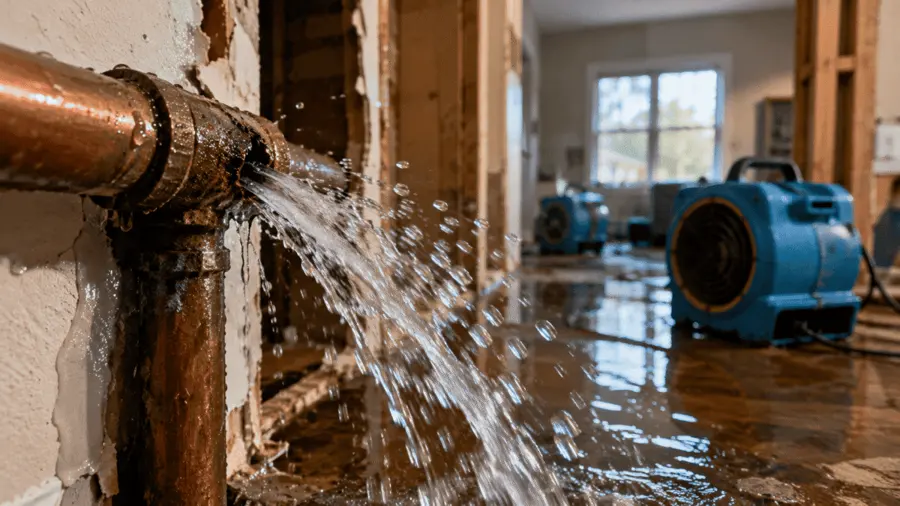
First steps for burst pipe cleanup in Greeley
- 1
Close the main
Every minute of spray adds gallons to the floor and walls.
- 2
Kill wet circuits
Switch off breakers for wet rooms if the panel is safely dry.
- 3
Move valuables
Lift rugs, electronics and papers off the wet floor.
- 4
Photograph, then call
Shoot the break and the spread before cleanup begins.
How burst pipe cleanup is handled in Greeley
Rapid local response
The response team rolls day or night across Greeley and Weld County, because a basement keeps soaking up water until extraction starts.
IICRC S500 drying standard
The drying team dries the structure, not just the surface, and pulls the equipment only when the readings say dry.
Claim-ready documentation
The tech who does the walkthrough maps the moisture, photographs the loss before demolition and logs daily readings for the adjuster.
Weld County water experts
Subzero cold snaps, hail season, window wells, swamp coolers and river flooding: local water damage experts know how water moves in a Greeley home.
What does burst pipe cleanup cost in Greeley, CO?
In Greeley, CO, burst pipe cleanup typically runs $1,200 to $7,500, depending on how long the line ran, the square footage that got wet and whether water reached a finished basement below.
| Scope of the loss | Typical range | What drives it |
|---|---|---|
| Caught fast, one room | $1,200 to $2,500 | Clean water, carpet or tile, extraction plus a short dry-out |
| Walls and two or three rooms | $2,500 to $5,000 | Baseboard removal, cavity drying, more equipment days |
| Ran for hours, two levels | $5,000 to $7,500+ | Ceiling drywall, basement extraction, Class 3 or 4 drying |
For a closer planning figure, run the water damage cost calculator. The final scope is set on site, after the moisture map.
The burst pipe cleanup process, step by step
- 1
Map the moisture
The tech who does the walkthrough finds the source, then maps moisture with thermal imaging and pinless meters before any equipment goes down.
- 2
Extract
The extraction crew pulls standing water with truck-mounted extraction, so the water leaves the building instead of spreading.
- 3
Set the drying plan
Air movers go in at each room's evaporation load, with LGR dehumidifiers, or desiccants for Class 4 materials, pulling the moisture back out.
- 4
Verify dry
Most crews log readings daily and pull equipment once wet materials sit within 2 to 4 points of a dry reference material.
Not every burst pipe in Greeley is a winter story. Supply lines fail in July too: corroded galvanized pipe in a 1960s ranch, a fitting that gives way under pressure, a braided hose behind a toilet or a water line nicked during a remodel. The result is the same, clean water under pressure spreading across floors and into walls until the main is shut.
Why supply lines fail in older Greeley houses
Much of Greeley's housing was built between the 1950s and the 1980s, and a lot of it still carries original plumbing.
- Galvanized steel lines that corrode from the inside and pinhole
- Copper joints weakened by hard water over decades
- Braided and plastic supply hoses on toilets and sinks that age out
- Pressure spikes when a municipal main is worked on
A pinhole leak inside a wall can run for weeks and show up as a soft baseboard or a stain. A full burst shows up in minutes as water on the floor.
Water spraying from a line? Close the main shutoff, then call so the extraction crew can start pulling water.
Call (888) 532-8620, burst pipe helpWhat the cleanup involves
Clean supply water is Category 1, the easiest water to dry, as long as the job starts quickly. Left sitting for a couple of days, it can pick up contaminants and turn into Category 2.
- Moisture mapping to find every wet wall, floor and ceiling
- Extraction of standing water and saturated carpet
- Baseboard removal and small access holes to vent wall cavities
- Air movers and LGR dehumidifiers with daily moisture readings
- Timestamped photos and logs for the insurance claim
Class of water loss
Class 1 through 4 sets how much equipment a room needs. A burst line that soaks one carpeted room is usually Class 2; the same water in hardwood or plaster becomes Class 4 and may need desiccant drying.
Burst pipe versus frozen pipe
A freeze split is its own case, covered on the frozen pipe cleanup page. When the burst line is overhead and the water comes through the ceiling, see ceiling leak water damage. For household plumbing tips that cut leak risk, EPA WaterSense Fix a Leak Week is a practical checklist, and Ready.gov covers electrical safety around standing water.
Burst Pipe Cleanup across Greeley and Weld County
Coverage for burst pipe cleanup runs across every Greeley ZIP and the towns around it.
Local water damage experts cover all of Greeley, from the Poudre on the north side to the South Platte and Evans on the south, with rapid local response around the clock.
Coverage takes in Greeley, Evans, Garden City, Windsor, Eaton, Kersey, LaSalle, Johnstown, Milliken and Severance, plus ZIP codes 80631, 80634 and 80639.
See every neighborhood and ZIP coveredBurst Pipe Cleanup questions, answered
What is the first thing to do when a pipe bursts?
Close the main shutoff valve. In most Greeley homes it sits in the basement where the water line enters from the street. Then keep people away from wet outlets and call.
Can drywall be saved after a burst pipe?
Often, when the water is clean and drying starts quickly. The drying team vents the wall cavities and dries in place, cutting out only drywall that stays wet or starts to break down.
How can a hidden pipe leak be found?
Thermal imaging shows cool, wet areas behind walls, and pinless meters confirm them without damage. That is how a slow leak is traced to the right stud bay.
Will the floor need to be replaced?
Tile and sealed concrete usually dry well. Carpet can often be dried in place. Laminate and some engineered flooring swell and may need to come up.
Does insurance cover a burst pipe?
Sudden and accidental discharge is commonly covered after the deductible; slow leaks over time often are not. Coverage depends on your policy, so it is worth checking with your own insurer.
How long does a burst pipe dry-out take?
Three to five days is common for a contained loss. Larger losses, hardwood floors and plaster walls take longer, and the equipment stays until the readings say dry.
Burst Pipe Cleanup in Greeley? Get the drying started today.
Standing water keeps wicking into drywall, trim and subfloor for as long as it sits. The Greeley restoration crew extracts, dries to the IICRC S500 standard and documents the loss.